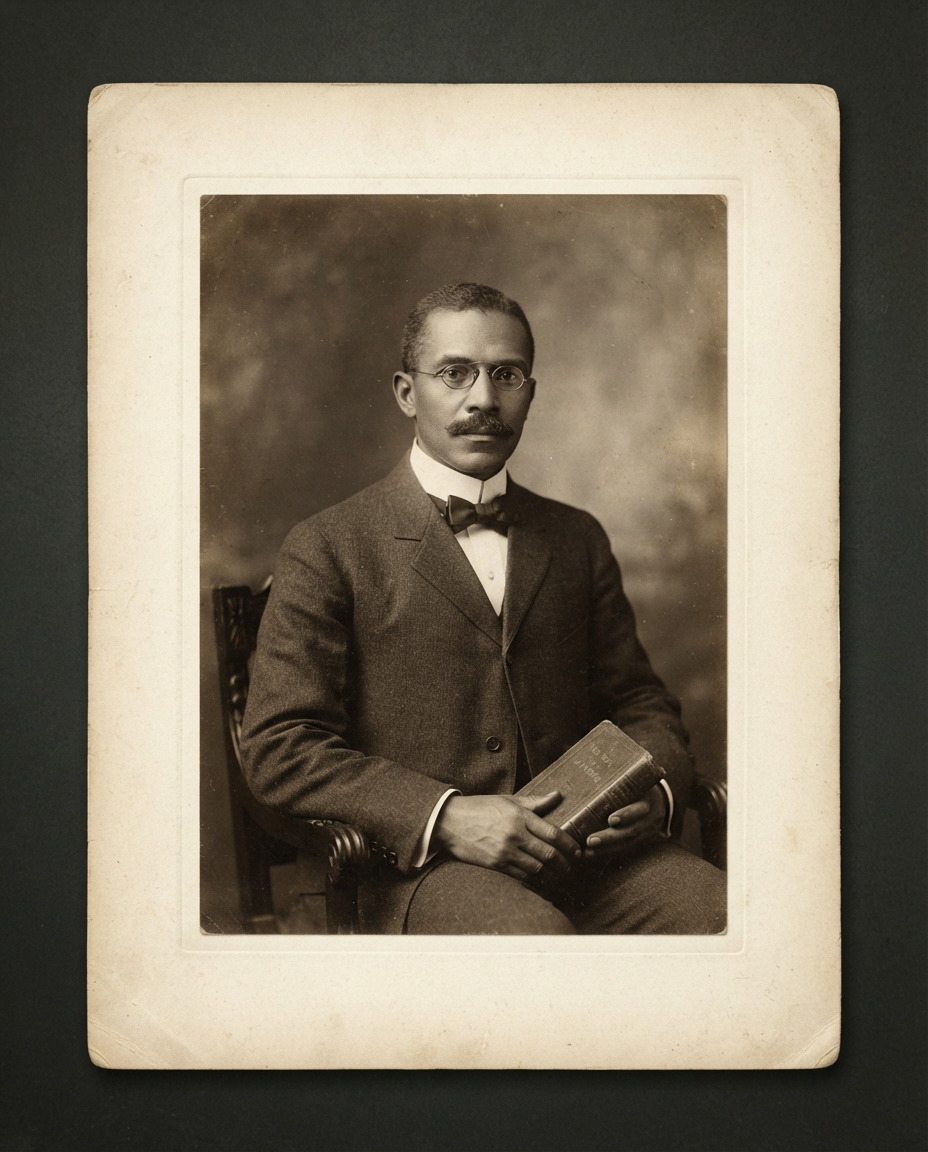
W. E. B. Du Bois
Scholar, Author & Civil Rights Pioneer
“The problem of the twentieth century is the problem of the color line.”
Biography
William Edward Burghardt Du Bois was born free in Great Barrington, Massachusetts, and became the first African American to earn a doctorate from Harvard University. A sociologist, historian, journalist, and activist, he produced some of the most important social science of the 20th century, beginning with 'The Philadelphia Negro' (1899), the first major empirical study of an urban Black community. In 1903 his landmark 'The Souls of Black Folk' reshaped American letters. In 1905 he co-founded the Niagara Movement, and in 1909 he helped found the NAACP, where he served as director of publicity and research and edited 'The Crisis' magazine for 25 years, making it the most widely read Black publication in America. His groundbreaking economic analysis of Black cooperative enterprise and his global Pan-African vision placed him at the center of the freedom struggle for six decades.
Major Accomplishments
- First African American to earn a Ph.D. from Harvard University (1895)
- Co-founder of the NAACP and editor of 'The Crisis' magazine from 1910 to 1934
- Author of 'The Souls of Black Folk' (1903), a foundational work of American literature and social thought
- Organized the first five Pan-African Congresses, building a worldwide movement against colonialism
- Pioneered the study of Black economic life, documenting Black-owned businesses and consumer cooperatives for the U.S. Bureau of Labor Statistics
Historical Significance
Du Bois insisted that full citizenship — the vote, education, and economic justice — could not be deferred. His 1898 and 1899 studies for the U.S. Department of Labor produced the first systematic surveys of Black-owned businesses in America, laying the intellectual groundwork for the cooperative economics movements that would later flourish in Black business districts. He connected local enterprise to global solidarity, arguing that the freedom of Black Americans was inseparable from the freedom of colonized peoples worldwide.
Legacy
Du Bois's vision animates the NAACP to this day, and 'The Crisis' continues in publication. His concept of the 'talented tenth,' his scholarship on Reconstruction, and his Pan-Africanism influenced generations of leaders from Martin Luther King Jr. to Kwame Nkrumah. In 1963, on the eve of the March on Washington, he died in Accra, Ghana — a citizen of the nation whose independence he had championed. His famous words on the color line remain the most quoted line in American race scholarship.
Interesting Facts
He was born the year the 14th Amendment was ratified and died the day before the March on Washington in 1963.
As a teenager he corresponded with the German chancellor Otto von Bismarck, who wrote back to him.
He organized the 'Exhibit of American Negroes' for the 1900 Paris Exposition, winning a gold medal for his hand-drawn data visualizations of Black American life.
In 1961 he joined the American Communist Party and moved to Ghana at age 93 to direct the Encyclopedia Africana project.
Sources & Further Reading
Credible references for the information presented on this page.